High purity quartz powder for semiconductor applications is not a headline material in chip manufacturing. It does not appear on process node roadmaps or equipment specification sheets. But it sits at the input end of several critical process steps, and when its quality is wrong, the consequences show up in wafer yield, device reliability, and ingot resistivity data that takes weeks to trace back to the source.
This guide covers every major semiconductor application that depends on high purity quartz powder, the specific grade and impurity requirements for each, the contamination pathways that matter most, and what sourcing decisions determine whether the material performs reliably in production. It is written for process engineers, materials procurement managers, and supply chain teams who need a single reference for quartz powder requirements across semiconductor applications.
Why High Purity Quartz Powder for Semiconductor Applications Matters
Semiconductor manufacturing uses silicon dioxide, SiO₂, in multiple forms across the fab. Thermal oxide grown on wafer surfaces, deposited oxide layers in CVD processes, and the fused quartz components used in process equipment all share a common ancestor: high purity silica in some form. For the fused quartz components that dominate semiconductor equipment, the starting material is high purity quartz powder melted and formed into the required geometry.
The purity requirements are strict because silicon is extraordinarily sensitive to contamination. At process temperatures above 1,000°C, metallic impurities in quartz components can migrate into the silicon being processed. Aluminum creates p-type doping that shifts resistivity. Iron and transition metals create deep-level electronic traps that reduce carrier lifetime and device yield. Alkali metals are mobile ions that degrade gate oxide integrity and cause long-term reliability failures in finished devices.
At the process node dimensions used in advanced logic and memory production, these contamination effects are not theoretical risks. They are yield and reliability variables that show up in production data. Controlling them starts with controlling the purity of the quartz powder used to produce the equipment components that contact silicon and silicon-related process gases throughout the fab.
Semiconductor Applications by Category
Czochralski Silicon Crystal Growth: Crucible Inner Layer
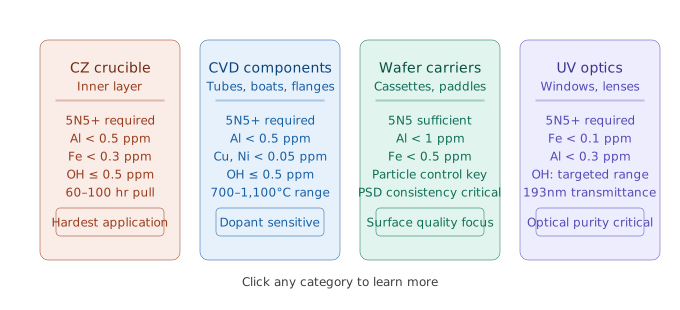
The most demanding application of high purity quartz powder for semiconductor applications is the inner layer of Czochralski CZ crystal growth crucibles. A CZ crucible holds molten silicon at temperatures above 1,414°C for pull cycles lasting 60 to 100 hours. The inner layer is in direct contact with the silicon melt for the entire duration of each pull. Every impurity present in the inner layer quartz powder is a potential contaminant for the ingot being grown.
The specific contamination mechanism and the grade requirements for CZ crucible inner layer applications are covered in detail in our guide to semiconductor crucible grade requirements and sourcing. The key parameters are SiO₂ purity at 5N5+ (99.9995% and above), aluminum below 0.5 ppm, iron below 0.3 ppm, combined alkali metals below 1 ppm, and hydroxyl content at or below 0.5 ppm.
The reason aluminum receives special attention in this application is worth understanding in detail. Unlike iron and the transition metals, which create electronic trap states in silicon, aluminum is a substitutional impurity. It occupies silicon lattice sites and acts as a p-type dopant. Even trace quantities of aluminum dissolved from the crucible inner layer into the silicon melt over a 100-hour pull cycle can shift the resistivity of the finished ingot outside specification. For n-type wafer production targeting specific resistivity ranges, aluminum contamination from the crucible is the primary source of pull-to-pull resistivity variation that cannot be explained by polysilicon feedstock variation alone.
The full contamination pathway, from quartz powder impurity content through crucible formation, silicon melt dissolution, and ingot incorporation, is explained in our article on silicon ingot contamination causes.
CVD Process Components: Tubes, Boats, and Flanges
Chemical vapor deposition processes in semiconductor fabs use fused quartz tubes, boats, paddles, and flanges to hold and transport silicon wafers through high-temperature deposition and diffusion steps. These components operate at temperatures from 700°C to above 1,100°C in reactive gas environments including silane, dichlorosilane, and various dopant gases.
The impurity requirements for high purity quartz powder for semiconductor applications like CVD components are similar in principle to crucible inner layer requirements, but the specific thresholds depend on the process step. Diffusion processes that intentionally introduce dopants into wafers are particularly sensitive to background contamination from equipment components, because any impurity that migrates from the quartz boat or tube into the wafer during a high-temperature diffusion step adds to the intended dopant profile in an uncontrolled way.
For advanced node CVD applications, the critical impurities to control in the source quartz powder are aluminum below 0.5 ppm, iron below 0.3 ppm, copper and nickel individually below 0.05 ppm, and sodium and potassium individually below 0.5 ppm. Uranium and thorium content at the sub-ppb level is a reliability concern for some advanced node applications because alpha particle emission from radioactive trace elements can cause soft errors in completed devices.
Quartz Wafer Carriers and Transport Components
Wafer carriers, cassettes, and transport paddles made from fused quartz are used throughout the fab to hold and move silicon wafers between process steps. These components operate at lower temperatures than CVD tubes and crucibles in many applications, but they contact wafer surfaces directly and represent a potential contamination source through particle generation and surface outgassing.
The quartz powder specification for wafer carriers places particular emphasis on surface quality of the finished component, which depends on the homogeneity of the powder used in production. Powder with inconsistent particle size distribution produces fused quartz with surface irregularities that generate particles during wafer handling. Particle contamination on wafer surfaces is a yield risk at any process node and a critical defect at advanced nodes.
Quartz Windows and Optical Components
Laser annealing, rapid thermal processing, and photolithography systems use fused quartz windows and optical elements that must maintain high optical transmittance in the ultraviolet and visible ranges. The optical performance requirements for these components add a dimension to the quartz powder specification that does not apply to structural components: optical purity.
Metallic impurities, particularly iron and transition metals, absorb light at specific wavelengths in the UV and visible range. A quartz window produced from powder with elevated iron content will show absorption bands that reduce transmittance and alter the spectral profile of the illumination system. For photolithography applications operating at 193nm or below, even trace-level absorption in the optical path can affect exposure uniformity and ultimately CD control on the wafer.
Hydroxyl content is also relevant for optical components in a way that differs from structural applications. For some UV optical applications, a specific OH content range is targeted rather than simply minimized, because OH affects both the refractive index and the UV transmittance of fused silica in ways that need to be matched to the optical design of the system.
Grade Requirements for High Purity Quartz Powder for Semiconductor Applications
| Application | SiO₂ Purity | Al (ppm) | Fe (ppm) | Alkalis (ppm) | OH (ppm) |
|---|---|---|---|---|---|
| CZ crucible outer layer | 4N · 99.99% | < 5 | < 1 | < 10 | Not controlled |
| CZ crucible middle layer | 5N · 99.995% | < 2 | < 0.5 | < 2 | Not controlled |
| CZ crucible inner layer | 5N5+ · 99.9995% | < 0.5 | < 0.3 | < 1 | ≤ 0.5 |
| CVD tubes and boats | 5N5+ · 99.9995% | < 0.5 | < 0.3 | < 1 | ≤ 0.5 |
| Wafer carriers | 5N5 · 99.995% | < 1 | < 0.5 | < 2 | Not controlled |
| UV optical components | 5N5+ · 99.9995% | < 0.3 | < 0.1 | < 0.5 | Targeted range |
| Advanced node (7nm and below) | 5N7 · 99.9997% | < 0.3 | < 0.1 | < 0.5 | ≤ 0.3 |
The thresholds in this table represent current industry practice for high purity quartz powder for semiconductor applications at established process nodes. Advanced node applications at 7nm and below are increasingly specifying tighter limits, particularly for aluminum, copper, and the alkali metals. If your application is not covered by the standard grade definitions above, contact us to discuss parameter-matched supply for your specific requirements.
The 3 Variables That Determine Performance in Semiconductor Applications
1. Chemical Purity: Individual Elements, Not Just Total Metals
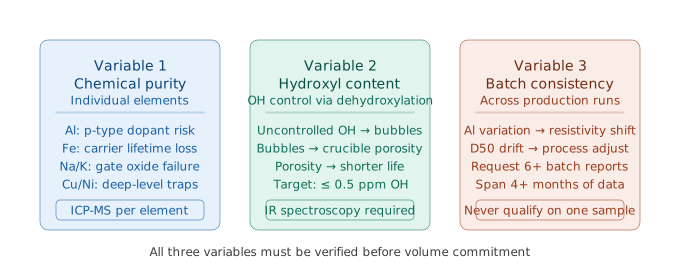
When sourcing high purity quartz powder for semiconductor applications, the SiO₂ purity percentage, the N-grade designation, describes only the silicon dioxide content of the material. It tells you nothing about the distribution of the remaining impurities among individual elements. Two batches of quartz powder both labeled 5N5+ can have very different aluminum and alkali metal profiles, and it is those individual element concentrations that determine semiconductor process performance.
For semiconductor applications, the specification must include maximum limits for aluminum, iron, potassium, sodium, lithium, copper, chromium, nickel, and titanium at the individual element level. Total metals figures are not a substitute. A supplier who provides only a total metals value without individual element breakdown is not providing enough information to qualify material for semiconductor use.
Our guide to 5N2 vs 5N5+ grade differences explains the practical implications of grade sub-classifications and why the headline purity number is only the starting point for specification development.
2. Hydroxyl Content: The Parameter That Separates Grades in Practice
Hydroxyl content, OH, is not captured by ICP-MS analysis. It requires infrared spectroscopy measurement and is a separate documentation item from the elemental purity report. In semiconductor applications, OH content matters for two reasons.
First, elevated OH in quartz powder causes bubble formation during the arc fusion process used to produce crucibles and fused quartz components. Bubbles weaken the component structure and create sites for accelerated dissolution or particle generation during process use. A crucible with inner layer porosity from bubble formation has a shorter effective life and a higher per-pull contamination rate than one produced from well-dehydroxylated powder.
Second, for CVD tube and diffusion furnace applications, OH content affects the thermal stability of the fused quartz component over repeated thermal cycles. Components produced from powder with uncontrolled OH content show accelerated devitrification, the conversion of amorphous fused silica to crystalline cristobalite, at process temperatures. Devitrified quartz generates particles and changes its mechanical properties in ways that affect component lifetime.
The production process step that controls OH content, dehydroxylation, and what to verify when evaluating a supplier’s OH control capability, is covered in our article on OH content requirements for high-purity quartz powder.
3. Batch-to-Batch Consistency: The Variable That Affects Production Stability
A qualification sample that meets all specification requirements proves that the supplier can produce compliant material once. Production supply requires consistent performance across every batch, every month, for the duration of the supply relationship. In semiconductor applications, batch-to-batch variation in aluminum or alkali metal content shows up as pull-to-pull variation in ingot resistivity, or as process shift in diffusion furnace applications that is difficult to trace back to the raw material without systematic incoming inspection data.
Evaluating consistency before qualifying a supplier requires requesting ICP-MS data across multiple production batches spanning several months, not just a single sample result. The methodology for this analysis is covered in our guide to evaluating batch-to-batch consistency in high purity quartz powder.
The 4-Stage Qualification Process for Semiconductor-Grade Quartz Powder
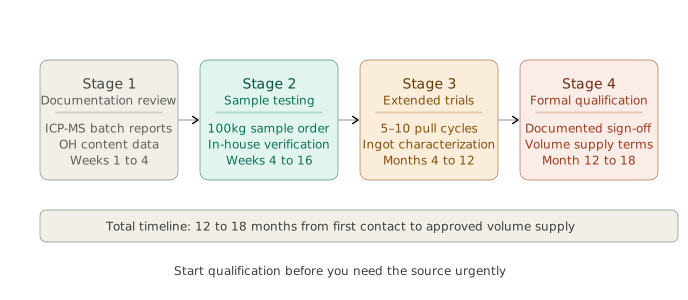
Qualifying a new quartz powder source for semiconductor applications is a structured process with defined stages and typical timelines. Understanding the full qualification cycle helps procurement teams plan supply chain transitions and alternative source development appropriately.
Stage 1: Documentation Review (Weeks 1 to 4)
The first stage evaluates whether the supplier’s documented capability meets the application specification without committing to sample testing. Request full ICP-MS batch reports with individual element values across at least six production batches, OH content measurement data for dehydroxylated grades, particle size distribution data from laser diffraction, and documentation of the ore source and purification process. Suppliers who cannot provide this documentation package are not ready for semiconductor qualification regardless of their marketing claims.
The seven questions to ask any potential supplier during this stage are covered in our guide to qualifying a high purity quartz powder supplier.
Stage 2: Sample Testing and In-House Verification (Weeks 4 to 16)
Request a production-representative sample of at least 100kg. Verify the sample against the supplier’s certificate of analysis using your own ICP-MS equipment or a third-party laboratory. Verify OH content by infrared spectroscopy independently of the supplier’s report. Measure particle size distribution and compare to the supplier’s data. Confirm that the sample lot number matches across all documentation.
In-house material testing should be followed by production trials using the sample material in the actual application. For crucible inner layer qualification, this means producing crucibles from the sample powder and conducting at least one ingot pull to verify that impurity transfer to the silicon melt is within acceptable limits.
Stage 3: Extended Production Trials (Months 4 to 12)
Extended trials run the qualified sample material through multiple production cycles to verify that the single-sample results are representative of ongoing supply. For CZ crucible applications, this typically means five to ten pull cycles using crucibles produced from the candidate powder, with ingot characterization data reviewed after each pull.
During extended trials, incoming inspection should be conducted on each batch received to verify consistency with the qualification sample. Any batch that falls outside the qualification data range should trigger a hold and supplier notification before use in production.
Stage 4: Formal Qualification and Volume Supply (Month 12 to 18)
Formal qualification requires documented sign-off from process engineering, quality assurance, and procurement, with the qualification data package archived as a controlled document. Volume supply agreements should include specification-matched working ranges rather than broad maximum-limit specifications, batch-level CoA requirements with individual element data, and incoming inspection rights with defined reject criteria.
Supply Chain Considerations for High Purity Quartz Powder for Semiconductor Applications
The supply chain for high purity quartz powder for semiconductor applications has changed materially in the past three years. The context for those changes and the implications for buyers evaluating Chinese sources are covered in our article on the China high purity quartz powder supply chain in 2026.
For semiconductor applications specifically, two supply chain considerations deserve attention beyond the standard qualification process.
Single-source risk is higher in semiconductor-grade quartz powder than in most industrial material categories. The number of suppliers globally who can consistently produce verified 5N5+ material with full ICP-MS batch documentation and controlled OH content is small. A supply disruption at your primary source, whether from production issues, logistics problems, or geopolitical factors, cannot be resolved quickly if you do not have a qualified alternative. Qualification timelines of 12 to 18 months mean that the time to develop a qualified second source is before you need one urgently.
Ore source changes are a hidden supply chain risk. Your qualified supplier may change their ore feedstock without this being visible in routine batch documentation, particularly if the new ore source meets the same specification limits even though its impurity profile is different from the material you qualified on. Contractual notification requirements for ore source changes, and mini-qualification protocols for new feedstock, protect against this risk in long-term supply relationships.
For procurement teams managing multiple fabs or process nodes, consolidating high purity quartz powder for semiconductor applications sourcing under a single qualified supplier with a documented second-source backup is the most resilient supply structure available given current market conditions.
How Gindtay Supplies High Purity Quartz Powder for Semiconductor Applications
We supply high purity quartz powder for semiconductor applications at electronic grade (5N2 to 5N5) and semiconductor grade (5N5+ and 5N7), produced from verified domestic Chinese ore sources characterized for lattice-bound impurity content. Our standard documentation package includes full ICP-MS batch reports with individual element values, OH content measurement by infrared spectroscopy, and particle size distribution data, all referenced to the same batch lot number.
Our verified 5N7 production capability is supported by third-party ICP-MS analysis showing SiO₂ at 99.9997%, with aluminum at 0.23 ppm, iron at 0.68 ppm, and combined alkali metals below 0.3 ppm. This data is available on request alongside multi-batch historical results for consistency evaluation.
We offer 100kg sample quantities for qualification testing at production specification. Our commercial MOQ is 50 metric tons with standard lead times of 6 to 7 weeks for first orders. We package in 200kg sealed drums under controlled dry conditions and can describe our packaging environment and seal verification process in detail.
For applications with specifications outside our standard grade definitions, we work with customers on parameter-matched supply: defining the exact impurity profile the process requires and verifying our material against that specification before the first commercial shipment.
Every inquiry for high purity quartz powder for semiconductor applications is handled with a full technical review of your specification before we recommend a grade or quantity.
To discuss your semiconductor application requirements and request our qualification data package, contact us at [email protected] or through the inquiry form on our product pages.
Summary
High purity quartz powder for semiconductor applications spans a range of use cases, from CZ crucible outer layers at 4N purity to advanced node CVD components and inner layer crucible material at 5N7. Each application has specific individual element requirements that go beyond the headline SiO₂ purity percentage, and OH content is a critical additional parameter for any application involving high-temperature processing.
Buyers sourcing high purity quartz powder for semiconductor applications for the first time should prioritize documentation quality and multi-batch consistency data over price in the initial qualification stage.
Qualifying a semiconductor-grade source requires a structured 4-stage process spanning 12 to 18 months, with documentation review, sample testing, extended production trials, and formal qualification sign-off. Supply chain resilience requires a qualified second source developed before the primary source faces a disruption event.
The three variables that determine performance are chemical purity at the individual element level, hydroxyl content control through dehydroxylation, and batch-to-batch consistency verified across multiple production runs. Getting all three right is what separates a stable production supply relationship from one that requires constant process adjustment and incoming inspection resources.
 English
  日本語
日本語  한국어
한국어  Español