
High purity quartz powder grade specification is one of the most misunderstood topics in industrial materials sourcing. The N-grade shorthand, 4N, 5N, 5N5+, gives procurement teams a quick framework for comparison, but it describes only the silicon dioxide content of the material. The individual impurity profile, the hydroxyl content, and the particle size distribution, which are the parameters that actually determine whether a material works in a specific application, are not captured by the grade label at all.
This guide explains the complete high purity quartz powder grade specification framework, from the N-grade system through individual element requirements, testing methods, and certificate of analysis interpretation. It is written for engineers and procurement managers who need to match material specifications to application requirements without overpaying for properties they do not need or underspecifying for applications that cannot tolerate contamination.
The N-Grade System in High Purity Quartz Powder Grade Specification
The N in 4N, 5N, and 5N7 counts the number of nines in the SiO₂ purity percentage of the material. The calculation is straightforward.
| Grade | SiO₂ Purity | Max Total Impurities | Typical Price Range |
|---|---|---|---|
| 4N | 99.99% | < 100 ppm | Baseline reference |
| 4N9 | 99.999% (transitional) | < 10 ppm | 1.5 to 2x baseline |
| 5N | 99.999% | < 10 ppm | 2 to 3x baseline |
| 5N2 | 99.992% | < 8 ppm | 2 to 3x baseline |
| 5N5 | 99.995% | < 5 ppm | 3 to 5x baseline |
| 5N5+ | 99.9995% | < 0.5 ppm | 8 to 12x baseline |
| 5N7 | 99.9997% | < 0.3 ppm | 12 to 20x baseline |
Two critical limitations of the high purity quartz powder grade specification system deserve explicit attention before any sourcing discussion begins.
First, the grade label describes a floor, not a complete specification. Two batches both labeled 5N5+ can have dramatically different aluminum and alkali metal profiles. One supplier’s 5N5+ material may have aluminum at 0.2 ppm; another’s may be at 0.45 ppm. Both are within the grade definition. For applications sensitive to aluminum, such as semiconductor crucible inner layers, this difference is material.
Second, the grade system says nothing about hydroxyl content. A 5N5 powder with uncontrolled OH content is not suitable for optical fiber preforms or semiconductor thermal applications regardless of its SiO₂ percentage. OH requires a separate measurement by infrared spectroscopy and must be specified independently of the N-grade designation.
For a detailed explanation of the practical differences between sub-grades, see our guide to 5N2 vs 5N5+ high purity quartz powder.
6 Critical Parameters in High Purity Quartz Powder Grade Specification
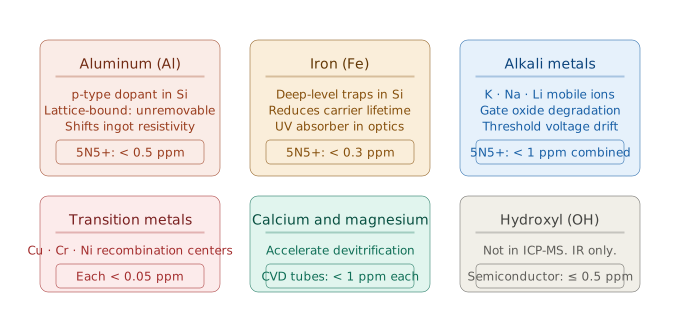
Complete high purity quartz powder grade specification for serious applications is built around individual element limits, not grade labels. The following six parameters drive specification decisions across semiconductor, optical fiber, Q-cloth, and fused quartz component applications.
1. Aluminum (Al): The Most Consequential Impurity
Aluminum is the single most important parameter in high purity quartz powder grade specification for two distinct reasons depending on the application.
In semiconductor applications, aluminum is a substitutional impurity in silicon. It occupies silicon lattice sites and acts as a p-type dopant. When aluminum migrates from a quartz crucible or CVD component into the silicon melt or wafer surface during high-temperature processing, it shifts resistivity. Even at sub-ppm levels in the quartz powder feedstock, aluminum contributes measurably to ingot resistivity variation over long pull cycles. For n-type wafer production, aluminum contamination from quartz components is a primary source of pull-to-pull variation that cannot be resolved by adjusting polysilicon feedstock purity.
In optical applications, aluminum degrades UV transmittance by creating absorption centers in the silica network. Quartz windows and lenses with elevated aluminum content show reduced transmittance at wavelengths below 250nm, affecting photolithography exposure uniformity.
Aluminum also presents a unique purification challenge. In natural quartz ore, aluminum exists in two forms: surface-bound aluminum that can be removed by acid leaching, and lattice-bound aluminum substituted within the SiO₂ crystal structure that cannot be removed by any surface chemistry. The lattice-bound fraction sets a hard floor on achievable aluminum content that is determined by ore selection, not purification process intensity. This is why ore source characterization matters as much as downstream processing for aluminum-sensitive applications.
2. Iron (Fe): Electronic Defect Generator
Iron creates deep-level electronic traps in silicon that reduce minority carrier lifetime. Unlike aluminum, iron is not a substitutional dopant but an interstitial impurity that forms complexes with other defects and dopants. The practical effect in semiconductor applications is reduced device yield and degraded performance in bipolar and power semiconductor devices that depend on long minority carrier lifetimes.
In optical applications, iron absorbs strongly in the visible and near-UV range, making it the primary cause of yellow or brown coloration in fused silica and the primary absorber degrading UV transmittance in quartz optical components.
Iron is generally easier to remove than lattice-bound aluminum through acid leaching, so well-controlled purification processes can achieve sub-0.1 ppm iron even from ores with moderate initial iron content. The key verification requirement is that the supplier demonstrates consistent iron control across production batches, not just in qualification samples.
3. Alkali Metals: Potassium, Sodium, and Lithium
Alkali metals, particularly sodium and potassium, are mobile ions in silicon dioxide. Under the electric fields and thermal gradients present in semiconductor device operation, sodium and potassium ions migrate through gate oxide layers and create threshold voltage instability. This is the mechanism behind alkali metal contamination being a device reliability concern rather than just a yield concern: wafers that pass initial electrical test can fail later in operation due to alkali-driven threshold drift.
Lithium, while present at lower concentrations than sodium and potassium in most natural quartz, has a particularly high diffusion coefficient in fused silica and silicon. It is the most mobile of the alkali metals and requires the strictest control in applications where diffusion into adjacent silicon structures is a concern.
Combined alkali specification, typically expressed as K + Na + Li total, is a standard CoA parameter for semiconductor-grade material. For 5N5+ applications, combined alkali below 1 ppm is a common requirement. For 5N7 advanced node applications, individual alkali elements are specified below 0.3 ppm each.
4. Transition Metals: Copper, Chromium, and Nickel
Copper, chromium, and nickel each create deep-level recombination centers in silicon with different energy levels and different effects on device performance. Copper is particularly concerning because it diffuses extremely rapidly in silicon at process temperatures, spreading contamination from a localized source across an entire wafer within minutes at diffusion furnace temperatures.
For semiconductor-grade quartz powder, copper, chromium, and nickel are typically specified individually below 0.05 ppm. Standard ICP-MS analysis covers these elements as part of the complete trace metal suite.
5. Calcium and Magnesium
Calcium and magnesium are less critical than aluminum, iron, and the transition metals in most semiconductor applications, but they affect the physical properties of fused quartz components in ways that matter for high-temperature applications. Calcium and magnesium accelerate devitrification, the crystallization of amorphous fused silica into cristobalite, at operating temperatures above 1,000°C. Devitrified quartz becomes mechanically brittle and generates particles that contaminate the process environment.
For CVD tube and diffusion furnace applications, calcium and magnesium specification below 1 ppm each is a standard requirement to maintain component lifetime and prevent particle generation.
6. Hydroxyl Content (OH): The Specification Outside the Grade System
Hydroxyl content is the sixth critical parameter in high purity quartz powder grade specification and the one most frequently overlooked in initial supplier qualification discussions. It does not appear in the N-grade definition. It is not measured by ICP-MS. And it is not listed on many supplier certificates of analysis even for material marketed as semiconductor or fiber grade.
OH groups form when water molecules are incorporated into the quartz crystal lattice during ore formation and during wet processing steps. In the finished powder, OH content is measured by infrared spectroscopy at the 2.73 micrometer absorption band. The result is reported in ppm by weight.
The consequences of uncontrolled OH content depend on the application. In optical fiber preform production, OH groups absorb infrared light at 1.38 micrometers and its harmonics, creating absorption peaks that increase signal attenuation in the finished fiber. For a detailed treatment of OH requirements in fiber applications, see our article on OH content requirements for optical fiber.
In semiconductor crucible and CVD component production, uncontrolled OH causes bubble formation during the arc fusion or flame fusion process used to produce the component from powder. Bubbles weaken the fused silica structure, reduce component lifetime, and create sites for accelerated dissolution or particle generation during process use.
The production step that controls OH content is dehydroxylation: controlled high-temperature treatment in a dry atmosphere that drives OH groups out of the material by converting hydroxyl bonds to bridging oxygen bonds within the silica network. Suppliers who cannot describe their dehydroxylation process in specific terms have likely not implemented it as a controlled production step.
Standard OH specifications by application tier:
- Standard telecommunications fiber: OH below 1.0 ppm
- Low-water-peak fiber (G.652D): OH below 0.5 ppm
- Semiconductor crucible inner layer and CVD components: OH at or below 0.5 ppm
- Ultra-low-loss fiber and advanced node semiconductor: OH below 0.3 ppm
- Specialty laser and UV optical components: OH in targeted range, application-specific
Particle Size Distribution in High Purity Quartz Powder Grade Specification
Particle size distribution is the physical dimension of high purity quartz powder grade specification, alongside chemical purity and hydroxyl content. It determines how the powder behaves physically in downstream processes: how it packs in crucible molds, how it melts in fiber drawing, how it disperses in resin systems for CCL production.
Particle size distribution is measured by laser diffraction and reported as percentile values. D50 is the median particle size; 50% of particles by volume are smaller than the D50 value. D90 is the size below which 90% of particles fall. The span, calculated as (D90 minus D10) divided by D50, describes the width of the distribution.
For crucible production, consistent D50 in the 90 to 180 mesh range with low span is the standard requirement. For Q-cloth fiber drawing, D50 consistency across batches is the primary concern because fiber drawing process parameters are tuned to a specific viscosity profile that depends on particle size. For optical fiber applications, particle size uniformity affects sintering behavior in preform production.
The full treatment of particle size specification requirements by application is covered in our guide to particle size distribution in high purity quartz powder.
Testing Methods for High Purity Quartz Powder Grade Specification
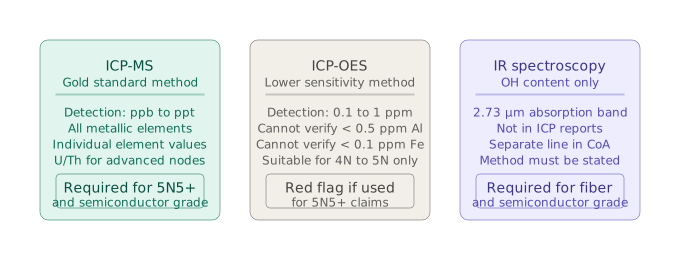
Understanding the testing methods used to characterize high purity quartz powder helps procurement managers evaluate supplier documentation more critically and ask better questions during qualification.
ICP-MS: The Required Method for 5N5+ Grade Specification
ICP-MS is the gold standard for trace elemental analysis in high purity quartz powder grade specification. It measures individual metallic elements at concentrations from parts per billion down to parts per trillion, making it the only method capable of verifying 5N5+ and 5N7 specifications at the required detection limits.
A complete ICP-MS report for semiconductor-grade quartz powder includes individual values for aluminum, iron, potassium, sodium, lithium, calcium, magnesium, copper, chromium, nickel, titanium, boron, and in advanced node applications uranium and thorium. Reports that list only selected elements or that report total metals without individual values are incomplete for qualification purposes.
ICP-MS analysis requires dissolution of the quartz sample in hydrofluoric acid, which is a specialist procedure. Not all analytical laboratories have this capability, and the sample preparation step introduces contamination risk if not controlled carefully. Third-party laboratory ICP-MS analysis is more credible than in-house analysis for initial supplier qualification.
ICP-OES: Insufficient for 5N5+ Grade Specification
ICP-OES has higher detection limits than ICP-MS, typically in the range of 0.1 to 1 ppm for most elements in quartz matrices. It is appropriate for verifying 4N and 5N material where individual element limits are above 1 ppm, but it is not suitable for verifying 5N5+ specifications where aluminum limits are below 0.5 ppm and transition metal limits are below 0.1 ppm.
When a supplier provides an ICP-OES report for material marketed as 5N5+ or semiconductor grade, the detection limits of the method are insufficient to verify the claimed specification. This is a meaningful qualification red flag.
Infrared Spectroscopy for OH Content
Hydroxyl content measurement requires infrared spectroscopy, specifically transmission IR or diffuse reflectance IR, analyzing the absorption band at 2.73 micrometers. The measurement must be performed on the powder or on a fused silica disk prepared from it under controlled conditions. Different measurement protocols produce results that are not directly comparable, so the measurement method should be specified in the CoA alongside the result.
OH content measurement is not a routine part of elemental analysis and is not included in ICP-MS or ICP-OES reports. It must be specifically requested and should appear as a separate line item in the documentation package for fiber-grade and semiconductor-grade material.
Laser Diffraction for Particle Size
Particle size distribution measurement by laser diffraction produces D10, D50, and D90 values that describe the volume-weighted size distribution of the powder. Results from laser diffraction are sensitive to sample preparation, particularly to whether the powder is dispersed in liquid or measured dry. The measurement protocol should be consistent across batches for results to be directly comparable.
Sieve analysis, which reports mesh size rather than percentile distribution values, gives less information than laser diffraction and should not be treated as equivalent.
How to Read a Certificate of Analysis for High Purity Quartz Powder Grade Specification
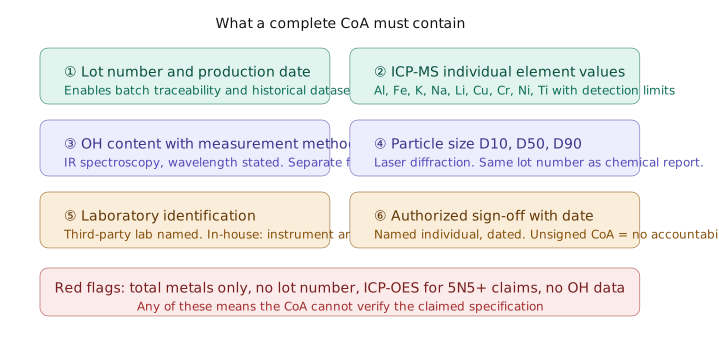
A certificate of analysis from a high purity quartz powder supplier should contain the following information as a minimum for semiconductor or fiber grade material.
The lot number and production date, which allow you to verify that the CoA corresponds to the specific batch you received and to build a historical dataset of batch performance over time. A CoA without a lot number cannot be traced to a specific production run and should be treated as a specification sheet rather than batch documentation.
ICP-MS results with individual element values and the detection limit for each element. The detection limit confirms that the analytical method is sensitive enough to verify the specification. If the detection limit for aluminum is 1 ppm and the specification calls for aluminum below 0.5 ppm, the CoA cannot verify compliance with the specification.
OH content measurement result and method. The measurement wavelength or method used should be stated so that results can be compared across suppliers on a consistent basis.
Particle size distribution with D10, D50, and D90 values from laser diffraction, and the measurement conditions used.
The laboratory that performed the analysis. Third-party laboratory analysis should identify the laboratory by name. In-house analysis should identify the analytical instrument and the internal quality control procedures applied.
Authorized sign-off with name and date. An unsigned or undated CoA provides no accountability for the accuracy of the reported values.
For a practical framework on evaluating supplier documentation quality as part of a full qualification process, see our guide to qualifying a high purity quartz powder supplier.
Matching Grade to Application: A Decision Framework
The correct high purity quartz powder grade specification for a given application is the lowest grade that reliably meets the application’s actual process sensitivity, not the highest grade that the supplier offers or the grade that sounds most impressive in a specification document.
Over-specifying has real costs: higher material price, smaller supplier base, longer qualification timelines, and tighter incoming inspection requirements, all with no process benefit if the application cannot distinguish between the grade specified and a lower one.
Under-specifying has different costs: contamination events, yield loss, process instability, and the difficulty of tracing root cause back to incoming material after the fact.
The decision framework starts with process sensitivity characterization. For each critical impurity, what concentration in the quartz powder feedstock produces a measurable effect in the downstream process or product? This requires process data, not just material data. The answer may be available from existing yield analysis, from published process studies, or from empirical trials with candidate materials at controlled impurity levels.
Once process sensitivity is characterized, set specification limits with a reasonable margin below the sensitivity threshold. A process that shows yield impact at aluminum above 0.8 ppm should specify aluminum below 0.5 ppm, not below 0.1 ppm, unless there is a specific reason to believe the sensitivity threshold will decrease.
For detailed application-specific grade guidance, see our articles on 4N vs 5N quartz powder grades and semiconductor crucible grade requirements.
Batch Consistency: The Hidden Dimension of Grade Specification
Every parameter in high purity quartz powder grade specification needs to be evaluated not just on a qualification sample but across multiple production batches spanning a meaningful time period. A single sample result proves that the supplier can produce compliant material once. Production supply requires consistent performance on every batch for the duration of the supply relationship.
Batch-to-batch variation in aluminum content causes pull-to-pull variation in silicon ingot resistivity. Variation in OH content causes inconsistent crucible porosity across production lots. Variation in D50 particle size requires process parameter adjustment between batches in fiber drawing applications. None of these effects are visible from qualification sample data alone.
The methodology for requesting and analyzing multi-batch consistency data, and the variation thresholds that are acceptable for different applications, are covered in detail in our guide to batch-to-batch consistency in high purity quartz powder.
Gindtay’s Grade Portfolio and Documentation Standard
We produce high purity quartz powder across the full grade specification range from electronic grade (5N2 to 5N5) to semiconductor grade (5N5+ and 5N7), from verified domestic Chinese ore sources. Our ore selection process includes characterization for lattice-bound aluminum and lithium content, which determines the achievable floor for these elements regardless of downstream purification intensity.
Our standard documentation package for all grades includes full ICP-MS batch reports with individual element values and detection limits, OH content measurement by infrared spectroscopy for dehydroxylated grades, and particle size distribution data with D10, D50, and D90 values from laser diffraction. All three data sets are referenced to the same batch lot number so that chemical, OH, and physical properties can be verified as simultaneously achieved in a single production run.
Our verified 5N7 production capability is documented by third-party ICP-MS analysis showing SiO₂ at 99.9997%, aluminum at 0.23 ppm, iron at 0.68 ppm, and combined alkali metals below 0.3 ppm. Multi-batch historical data is available on request for buyers conducting consistency evaluation before qualification commitment.
We offer 100kg sample quantities for in-house verification at production specification. Commercial MOQ is 50 metric tons with lead times of 6 to 7 weeks for first orders. For applications with specifications outside our standard grade portfolio, we discuss parameter-matched supply: defining the exact impurity profile required by your process and verifying our material against that specification before the first commercial shipment.
Contact us at [email protected] to request our qualification data package or to discuss your specific high purity quartz powder grade specification requirements.
Summary
High purity quartz powder grade specification covers six critical parameters: aluminum, iron, alkali metals, transition metals, calcium and magnesium, and hydroxyl content. The N-grade label describes only the SiO₂ purity floor and is an incomplete specification for any serious application.
The three dimensions of complete specification are chemical purity at the individual element level, hydroxyl content measured by infrared spectroscopy, and particle size distribution measured by laser diffraction. Testing method selection matters: ICP-MS is required for 5N5+ verification, ICP-OES is insufficient, and OH content requires a separate IR measurement not included in any elemental analysis report.
Matching high purity quartz powder grade specification to application requires process sensitivity characterization, not grade label comparison. The correct specification is the one that reliably meets your process requirements with appropriate margin, at the lowest grade that achieves this, with documented batch-to-batch consistency verified before volume commitment.
 English
  日本語
日本語  한국어
한국어  Español